Compás, music and cante · Music and cante · Garrotín
Dancing through listeningSignals, responses and the musical wave
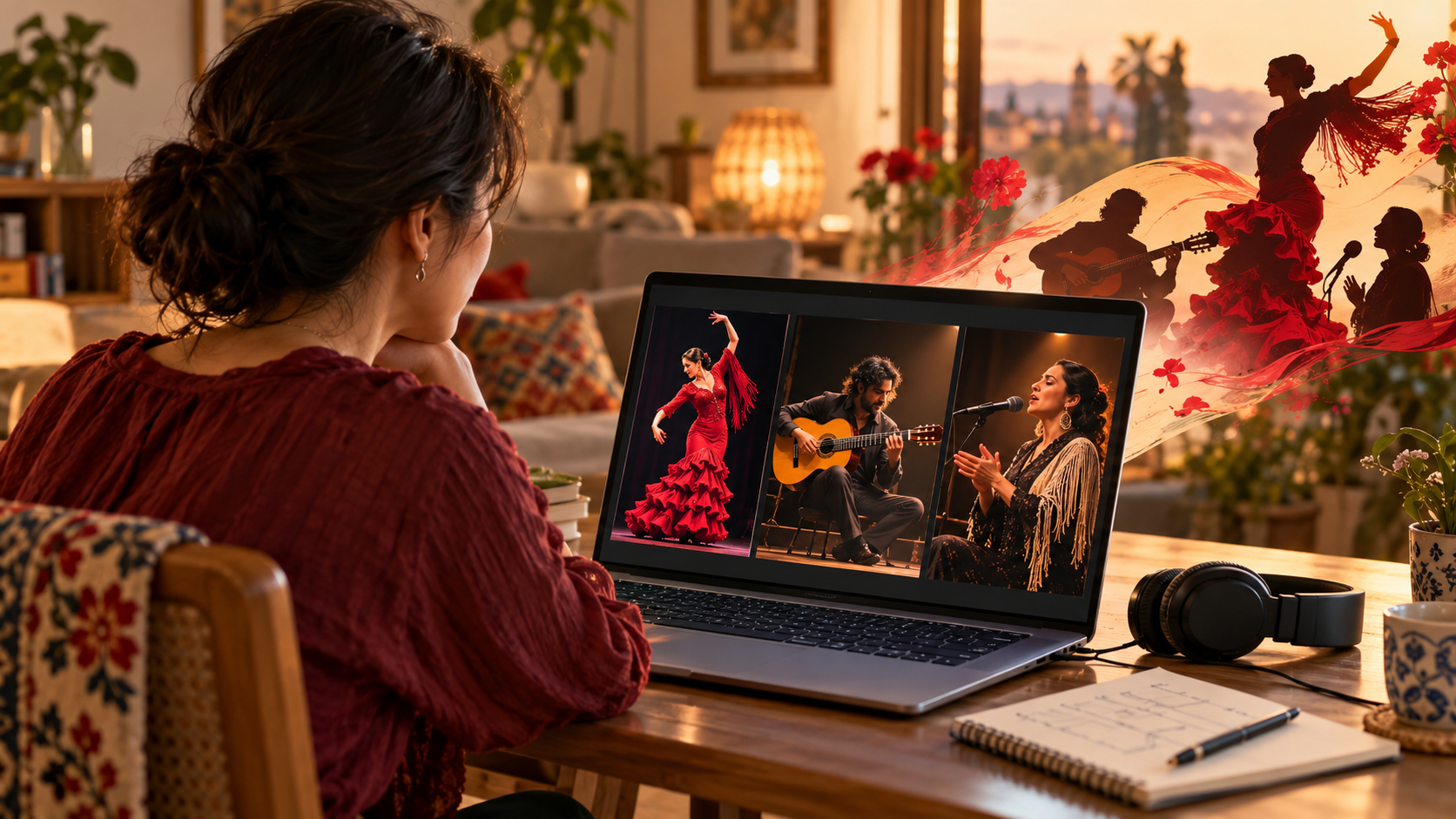
Live music is not a fixed recording. Dancing means listening, sending signals and building dynamics together with the musicians.
Watch the source videoCentral idea
The guitar is not background sound. Dancing to live music means building a relationship in real time.
1. Listening is dancing
The dancer maintains her pulse while listening to the guitar's colour, intensity, ornamentation and changes.
2. Signal → response
An accent, a glance, the direction of the body or the energy of a step can become a signal the guitarist understands.
3. The dancer also shapes the music
She does not only receive accompaniment: she can bring about a change in intensity, colour or dynamics.
4. Build a “wave”
Not everything strong. Not everything soft.
Soft → growing → strong → release.
5. Mistakes with intention
During a continuous run-through, a mistake should not force the dancer to stop or reduce her presence.
Make mistakes moving forward, not retreating.
6. Listening changes the same choreography
The quality of the dance can change profoundly without adding new steps when the listening changes.
7. Live music ≠ a fixed recording
If we always expect exactly the same response, we lose the essence of the live relationship. Communication changes what happens.
Reusable exercise
- Choose two points in an escobilla.
- At point A, ask for softness.
- At point B, ask for strength.
- Use accent + gaze + body.
- Complete a full run-through without stopping.
- Afterwards, review which signals were actually understood.
BG sequence
LISTEN → SIGNAL → RECEIVE A RESPONSE → ADAPT → CONTINUE
Source and class context
More flamenco on YouTube
Keep learning with BG FLAMENCO, Benito García’s channel.